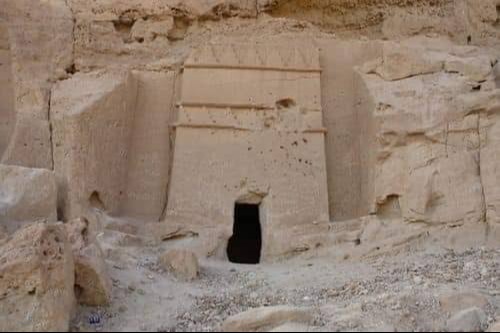
Nabataean Tombs of Al Bad
The Nabataean rock-cut tombs of Al Bad, a caravan-route town that ranked after Petra and Hegra among Nabataean tomb sites.
Al Bad, in the Tabuk Region near the Gulf of Aqaba, is one of the main Nabataean tomb sites after Petra and Hegra, though smaller. It was a city on caravan routes, surrounded by necropolises. Its tombs are cut into reddish sandstone, and the facades compare with those of Petra and Hegra. They date to about the first century CE, and some interiors carry inscriptions in Nabataean and Lihyanite.
About 35 rock-cut tombs are known at Mughayir Shuayb and Al Asifir. They were collective burials reused over the centuries, each facade is different, and the sandstone is poor for carving, which is why many carved details have worn away. A Roman fort and a diploma of 142 CE granting citizenship to a Nabataean soldier were also found at Al Bad, showing how long the town stayed on the trade routes.
Part of the same group, about 2 km south of the town, is known locally as Magha'er Shuaib or Jethro's Tombs, a tradition covered on its own page. Check access arrangements before you go.
Q. Who built the tombs at Al Bad?
A. The Nabataeans, in about the first century CE.
Q. How many tombs are there?
A. About 35 are known at Mughayir Shuayb and Al Asifir; counts vary with the area included.
Q. How does Al Bad compare with Hegra?
A. It is smaller, but it ranks as one of the main Nabataean tomb sites after Petra and Hegra.
See it with a local guide
Meet Arabia's Architects
Nabataean Tombs of Al Bad is part of our three-day journey through the Nabataean kingdoms of northwest Arabia, led by certified local guides: Hegra, AlUla Old Town, the rock-cut tombs and more. Tell us your dates and we will plan it with you.
You can also visit Nabataean Tombs of Al Bad on its own, not only as part of this journey: create your own path with just the places you want.